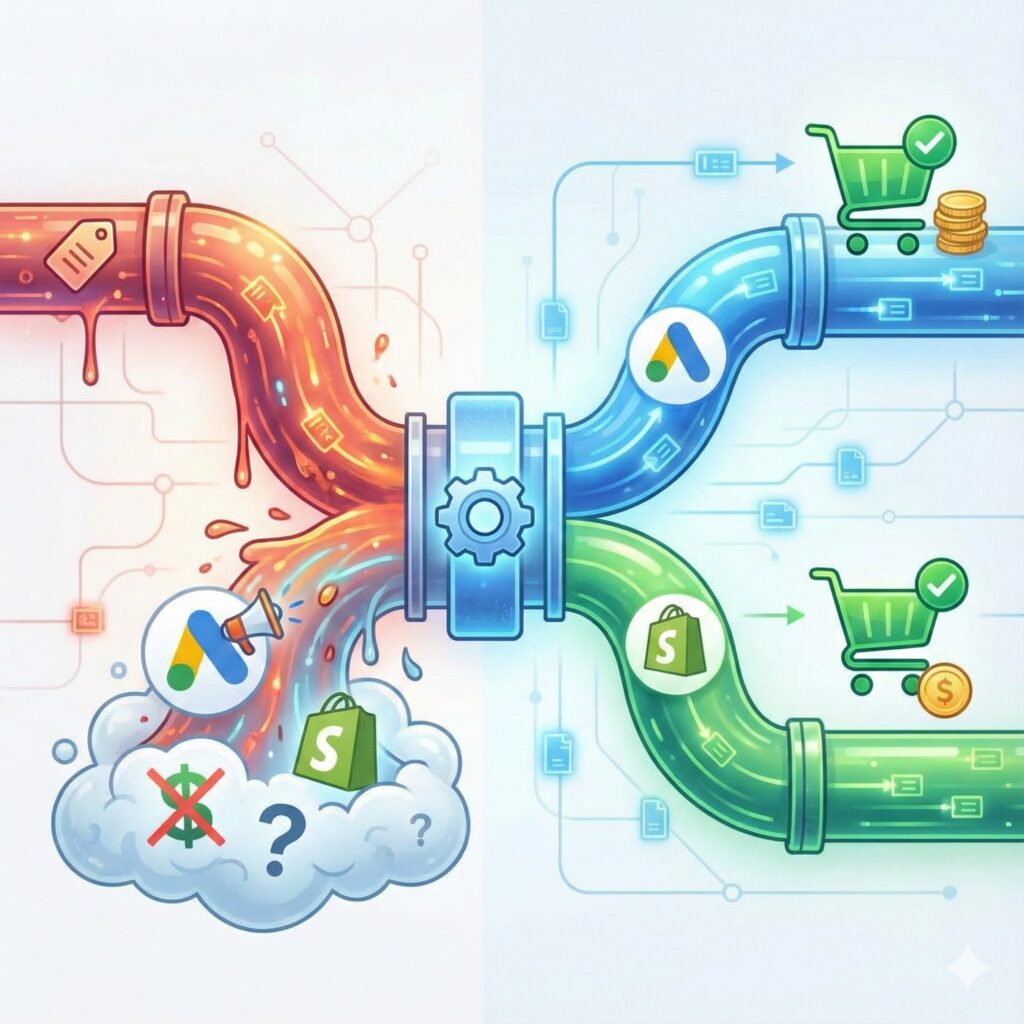
The 0.11 ROAS Problem: Why This D2C Funnel Collapsed (And Why Ads Were Not the Real Problem)
A GrowthLens teardown of what truly drives or destroys D2C performance.
A D2C skincare brand for women over 30 reached out with a familiar concern:
“Our Meta ads are not performing.”
At first glance, it looked like a media buying issue.
But once the system was evaluated end to end, the picture became clearer.
The ads were not the source of the problem.
They were simply revealing what was already happening inside the funnel.
This audit shows why performance dropped, and why this pattern repeats across many D2C brands.
The Surface Metrics Suggested an Ads Problem
Inside the ad account, the symptoms looked typical of a struggling setup:
- ROAS: 0.11
- CAC: 8,000
- CPM: 300 to 650
- Eight to ten ad sets inside single campaigns
- Traffic, Leads, Messages, and Sales objectives running at the same time
- Retargeting as the second highest spend with frequency above 10
- Pincode targeting tightening delivery
- Instagram conversation optimisation slowing purchase signals
- Missing catalog signals
These metrics explain the instability, but not the root cause.
The real question is always:
What are users doing after the click?
Because algorithms do not generate intent.
They respond to it.
Validate Tracking Before Drawing Conclusions
Before interpreting campaign performance, the tracking foundation must be verified.
- GA4 purchase events
- Pixel behaviour
- Attribution pathways
- Checkout instrumentation
- Event integrity
Everything was clean.
No signal loss, duplication, or attribution distortion.
Which meant the performance issue was not caused by misfiring data.
The answer was in the behaviour that followed the click.
Behaviour After the Click Revealed the Real Bottleneck
GA4 and Hotjar pointed to a clear behavioural pattern.
A single datapoint stood out immediately: four to seven seconds average PDP engagement.
Supporting behavioural signals reinforced the same issue:
- Less than 30 percent scroll depth
- Product video completion under 25 percent
- Testimonials not aligned to the 30 plus persona
- Above the fold that did not establish relevance
- Checkout with limited trust cues
Users were not disengaging because the ads were wrong.
Users were disengaging because the product story did not become clear quickly enough.
A straightforward question clarifies this:
If someone has only seven seconds, can they understand the product and its relevance to them?
In this case, the answer was no.
Low clarity reduced trust.
Low trust reduces engagement.
Weak engagement produced inconsistent intent signals.
With weak signals, optimisation could not stabilise.
The constraint originated at the PDP, long before the ads became a factor.
The CTS Loop: A Model That Explains Most D2C Underperformance
Across different D2C categories, the same structural pattern repeats. The model that captures it is the CTS Loop:
Clarity to Trust to Signal to Optimisation to Scale
1. Clarity
The user must understand the product and who it is for within seconds.
2. Trust
They must believe it can work for someone like them.
3. Signal
Their behaviour must indicate interest: scroll depth, dwell time, ATC, or video completion.
4. Optimisation
Platforms need consistent signals to learn effectively.
5. Scale
Only after optimization stabilises does cost and volume become predictable.
In this case:
- Clarity did not land
- Trust did not form
- Signals were weak
- Optimisation stalled
- Scale was not viable
Once the CTS Loop becomes clear, the same pattern starts appearing across many underperforming D2C funnels.
The Root Cause in One Line
The funnel was not aligned to the person closest to conversion.
A 30 plus woman with trust heavy skincare needs could not see herself clearly or quickly in the product story.
Every performance metric was downstream of this misalignment.
Rebuilding the Funnel: Correcting Fundamentals, Not Running More Tests
With the root cause identified, the recovery plan focused on fundamentals instead of high-velocity experimentation.
First: Improve Clarity
- Sharper above the fold
- Direct persona fit
- Clear articulation of purpose and benefit
Second: Strengthen Trust
- Replace testimonials with age relevant proof
- Add credible evidence and clear expectations
- Ensure consistency between claims and delivery
Third: Stabilise Behavioural Signals
- Improve dwell time
- Reduce friction
- Maintain message continuity from ad to PDP
Fourth: Restore Optimisation Pathways
- Remove campaign complexity
- Align objectives
- Build a predictable learning environment
The goal was to stabilize intent signals before attempting to scale.
The Principles That Matter Most for D2C Performance
1. Ads fail last. Funnels fail first
The origin of underperformance is almost always behavioural.
2. Behaviour is the strongest leading indicator.
Dwell time and scroll depth reveal issues earlier than revenue.
3. Algorithms follow human behaviour.
When users hesitate, performance slows. When users trust, optimization strengthens.
4. The CTS Loop is the real funnel.
Clarity to Trust to Signal to Optimisation to Scale.
5. Diagnose in sequence.
Data to Behaviour to Clarity to Trust to Intent to Signals to Optimisation to Scale.
This sequencing avoids waste and builds structural performance.
The Truth Beneath All the Metrics
At the end of the audit, the founder looked at the full picture and said something straightforward:
“So the problem was deeper than the ads.”
That was accurate.
Growth is not a media problem. Growth is a meaning problem.
When meaning is unclear or unconvincing, the metrics will show it immediately.
When meaning is strong and consistent, clarity improves, trust builds, and intent stabilises.
Performance follows from there.
Strengthen meaning.
Strengthen clarity.
Strengthen trust signals.
And the system reflects those improvements.
This is the core of GrowthLens.
Once you operate with this lens, the approach to building and optimising becomes far more disciplined and effective.